The History of the Noahide Laws
The Seven Noahide Laws did not emerge from a single moment in history. They were revealed progressively through key figures of the ancient world — each one adding a layer to the universal moral code that God intended for all of humanity.
Adam & Eve — The First Commandments
The Garden of Eden
The story begins at the very dawn of human existence. When God placed Adam and Eve in the Garden of Eden, He gave them the first divine instructions: to be fruitful and multiply, to tend the garden, and — most significantly — to refrain from eating the fruit of the Tree of Knowledge of Good and Evil.
According to rabbinic tradition, six of the seven Noahide Laws were already given to Adam. These included the prohibitions against idolatry, blasphemy, murder, theft, and forbidden sexual relations, as well as the positive command to establish courts of justice. Adam and Eve were the first recipients of God's moral law — the ancestors of all humanity, and thus the original trustees of these universal principles.
Their transgression — eating the forbidden fruit — demonstrated the central human struggle: the tension between divine instruction and personal desire. Yet even in their exile from the Garden, the laws God gave them remained binding on all their descendants.
Noah — The Seventh Law is Added
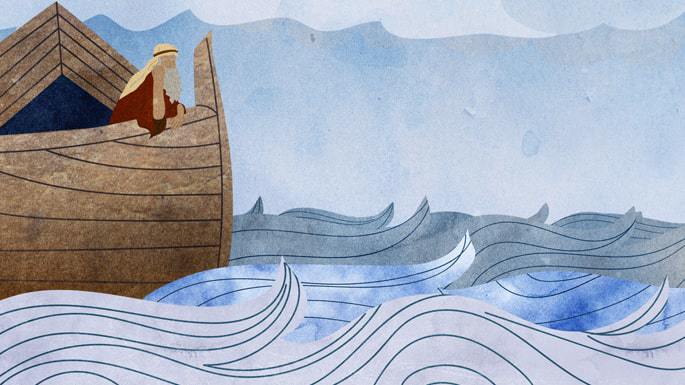
After the Great Flood (Genesis 9)
After the Great Flood, God made a covenant with Noah — the sole righteous man of his generation — and through him, with all of humanity. It is at this moment that the seventh and final Noahide Law was added: the prohibition of eating a limb torn from a living animal (Ever Min HaChai).
God had just permitted Noah and his descendants to eat meat for the first time. But with this permission came a boundary: life must be respected even in the act of taking it. An animal must be properly slaughtered — not consumed alive. This law expressed the principle of compassion toward all living creatures.
The rainbow God set in the sky became the eternal sign of this covenant — a promise never again to destroy the world, and an affirmation that these seven laws would govern all of Noah's descendants: every nation, every people, every human being who would ever live.
"I have set My rainbow in the clouds, and it will be the sign of the covenant between Me and the earth." — Genesis 9:13
Moses at Sinai — The Laws are Formalized in the Torah
Mount Sinai (circa 1313 BCE)
Though the Noahide Laws predate Moses, it is at Mount Sinai that they were formally codified and their obligatory nature confirmed for all non-Jewish peoples. When Moses received the Torah, the Noahide Laws were included within it — not merely as ancient tradition, but as divine legislation with legal force and consequence.
The Talmud (Sanhedrin 56a–60a) records the full details of the seven laws as transmitted through Moses. According to Maimonides (Rambam), a non-Jew who observes the Noahide Laws because God commanded them through Moses at Sinai — not merely because they seem reasonable — is considered among the righteous of the nations and has a share in the World to Come.
This distinction is critical: the Noahide Laws are not a philosophical framework or a human ethical system. They are the direct word of God, transmitted through the greatest prophet in history, and recorded for all generations in the Torah.
Rambam — Codifying the Laws for All Nations
Rabbi Moses ben Maimon (1138–1204 CE)
Rabbi Moses ben Maimon — universally known as the Rambam or Maimonides — was one of the greatest Jewish scholars and philosophers of all time. In his monumental legal code, the Mishneh Torah, he dedicated an entire section (Hilchot Melachim, chapters 8–10) to the Noahide Laws, laying out their details with remarkable precision and clarity.
The Rambam was the first to systematically present the Seven Laws as a complete legal code for all of humanity. He addressed who is obligated, what each law entails, the penalties for violation, and the spiritual standing of non-Jews who observe them faithfully. His writings became the definitive halachic source for Noahide Law and remain so to this day.
Perhaps his most enduring contribution was his declaration that it is a mitzvah — a divine obligation — for Jews to teach the Noahide Laws to the nations of the world. This planted the seeds for the modern Noahide movement centuries before it would fully bloom.
Chabad — Spreading the Noahide Laws to the World
The Lubavitch Movement (18th century – present)
The Chabad-Lubavitch movement, founded by Rabbi Schneur Zalman of Liadi in the 18th century, has become one of the most active forces in spreading awareness of the Noahide Laws to non-Jewish people around the world.
The seventh Lubavitcher Rebbe, Rabbi Menachem Mendel Schneerson (1902–1994), made the dissemination of the Seven Noahide Laws a central mission of Chabad. He taught that the world's redemption is bound up with humanity's acceptance of these laws, and he repeatedly urged his followers — and world leaders — to promote them actively.
In 1991, the United States Congress passed a resolution — signed by President George H.W. Bush — recognizing the Seven Noahide Laws as "the bedrock of society from the dawn of civilization" and declaring Education Day USA in honor of the Rebbe's birthday. This gave the Noahide Laws a remarkable moment of recognition on the world stage.
Today, through Chabad centers, online resources, and the work of organizations like AskNoah International, tens of thousands of people worldwide identify as Noahides — living according to these ancient, universal laws as their path to God and to a righteous life.